
Expertise in robotics and special-purpose machinery
Welding a medical device or parts weighing several tonnes, assembling magnets onto a rotor or handling ruby wafers under laminar flow: these automated operations have things in common, but each calls for a different approach. My strength is adapting proven techniques (handling, assembly, palletising, bonding, welding, inspection) to the precise requirements of your project.
Industrial robot integration and complex grippers
From miniature delta robots handling watch components weighing a few grams to 6-axis robots mounted on gantries, I have led the integration of industrial robots into a wide variety of production cells. My role: choosing the right robot, designing its gripper and guaranteeing the accuracy and throughput of the whole system.


All types of robot
I integrate all types of industrial robot: 6-axis, SCARA, delta, Cartesian, collaborative and humanoid. I have particular experience with Stäubli, KUKA, Fanuc and ABB robots, while remaining open to other brands to suit your standards.
I specify the robot and lay it out in CAD to suit your application (reach, payload, footprint, tool TCP position and singularity zones to avoid), which is sufficient in most cases. For complex paths or cycle-time optimisation, I also oversee validation by simulation.
Compact grippers
When a 6-axis robot tends an overmoulding press or a machining centre, every movement must be optimised and the payload kept under control to meet the cycle time. The challenge: fitting actuators and sensors into a gripper compact enough to reach the working area safely.
The number of functions a gripper needs is often inversely proportional to the space available.
Cable management and tool changing
I design the routing of cables, hoses and torch cable packages so that they follow every robot movement without wear or snagging. I integrate automatic tool changers when the cell has to perform several operations in sequence.
Robotic welding
I have also led robotic welding projects, including multi-pass welding: equipment selection, sensor-based seam tracking, and cell safety designed so that operators can work as close to the process as possible.
Cartesian robots and gantries
A 6-axis or SCARA robot works within a circular envelope around its base. When the application requires long strokes or linear movements, there are two solutions: a Cartesian robot made up of several electric linear axes, or a 6-axis robot combined with additional linear axes.
Multi-axis coordination
For large parts or complex paths, a 6-axis robot can be combined with additional axes: an XYZ gantry, a linear track or a workpiece positioner. I have led the development of cells that synchronise all these axes for accurate, continuous path following. Positions are expressed in Cartesian coordinates (X, Y, Z and orientations) in well-defined reference frames, and rotations are represented by quaternions, for unambiguous orientations and smooth interpolation.
Repeatability, accuracy and calibration
A repeatable robot is not necessarily an accurate one.
An industrial robot returns to the same point with excellent repeatability, but its accuracy, meaning the deviation between the commanded position and the position actually reached, varies with its configuration, especially on large multi-axis systems.
Depending on the process requirements, I define the right strategy: calibrating each tool’s TCP in its working configuration, calibrating the robot’s kinematic model using metrology, or real-time correction by a sensor mounted as close as possible to the tool, in the same reference frame.


Mechanical design
Trained as a microengineer, I started my career in mechanical design. I work mainly in SolidWorks and also have experience with Pro/ENGINEER (now PTC Creo), particularly in surface modelling. Depending on the size of the project, I do the design myself or lead the team of designers and draughtspeople.
Mechanisms and kinematics
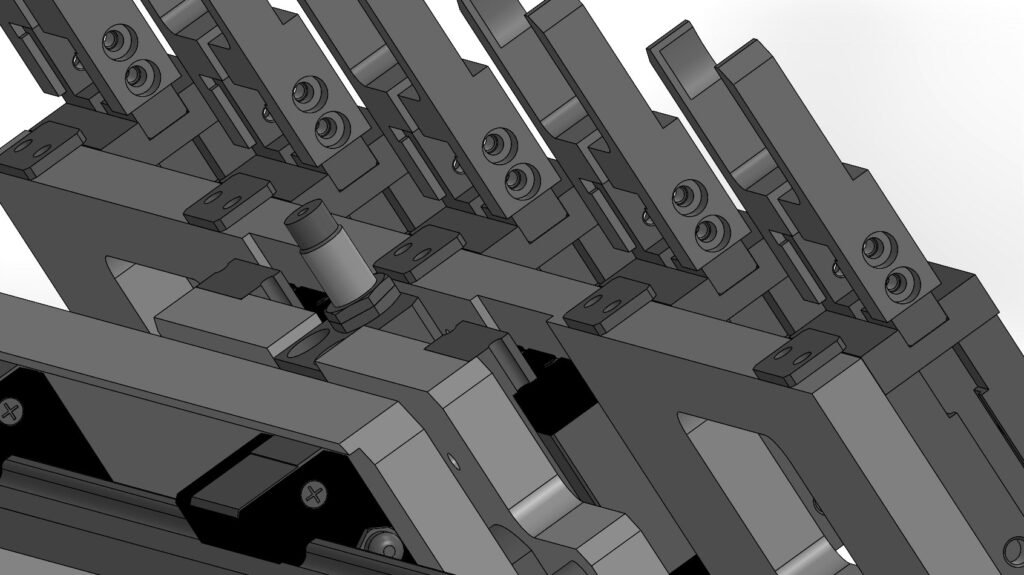
I design precision mechanisms and custom kinematics (robotic modules and grippers, manipulators, feeding systems, etc.), sized for the dynamics involved: moving masses, accelerations and vibrations.
The goal: reaching the target throughput with a high OEE, thanks to reliable mechanisms that are easy to maintain.
Sheet metal and machine frames
Using the SolidWorks sheet metal module, I design chassis and guarding, machine frames and welded structures, all designed for manufacture: laser cutting, bending and assembly.
I also have experience with large equipment, gained in close collaboration with mechanical teams: structural stiffness, deflection under load and accuracy of long axes.
Injection-moulded plastic parts
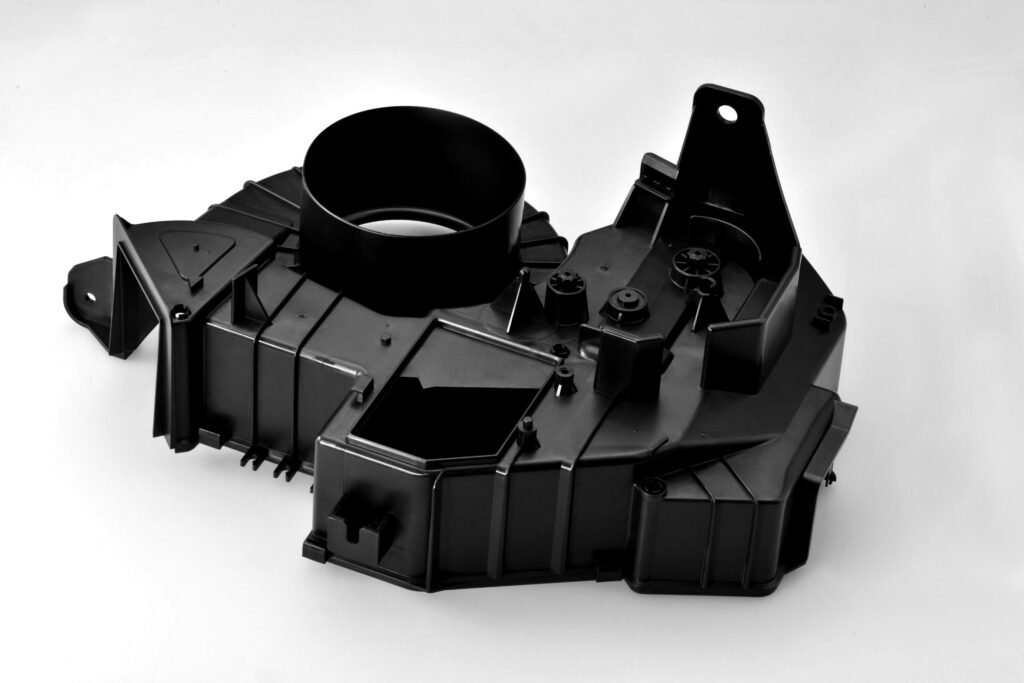
Design of injection-moulded parts, including surface modelling for complex shapes, taking moulding constraints into account (draft angles, wall thicknesses, shrinkage).
Tooling and fixtures
Production tooling, fixtures and grippers: parts that must be accurate, robust and easy to adjust.
From 3D model to manufacturing documentation
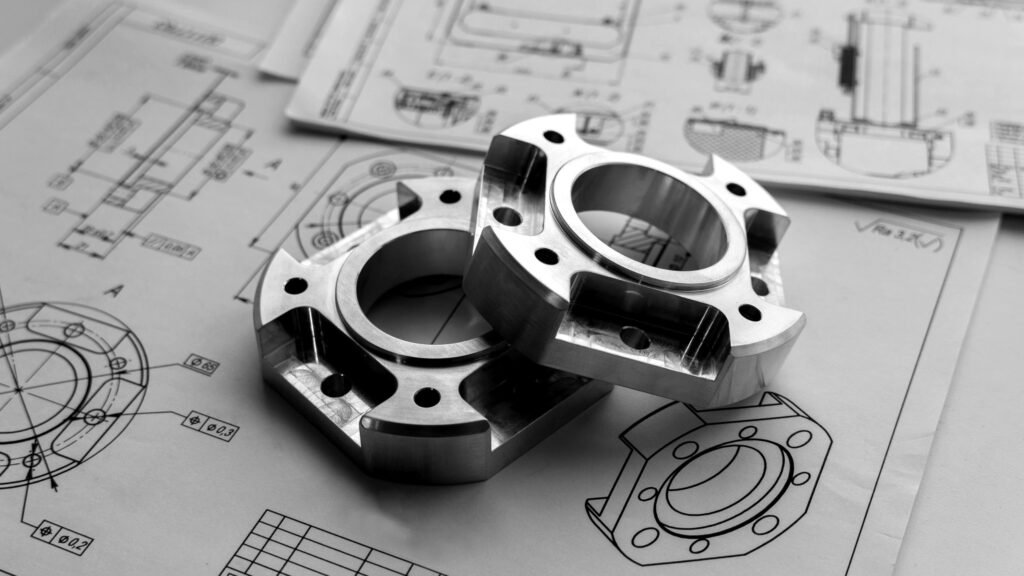
3D modelling, drawings, functional dimensioning and tolerancing, bills of materials: I deliver a complete manufacturing package, ready for use by your workshops or subcontractors.
Engineering data management
As a SolidWorks PDM administrator, I can structure the management of your engineering data: drawing approval workflows, revision control and design standards.
Standardisation and knowledge reuse
I have studied and developed standardised production equipment platforms. I know how to build on what already works: proven modules, design standards and reusable components, to reduce the lead time, cost and risk of each new project.
Every project benefits from the experience of the last.
Electrical engineering, automation and machine safety
Electrical engineering, automation and machine safety are inseparable from any special-purpose machine, and I have managed these areas by leading the specialist teams. While I don’t draw the schematics or write the programs myself, I have a firm grasp of the issues, standards and stages involved: I define the requirements, coordinate the specialists and validate the results.
Electrical architecture and control cabinets
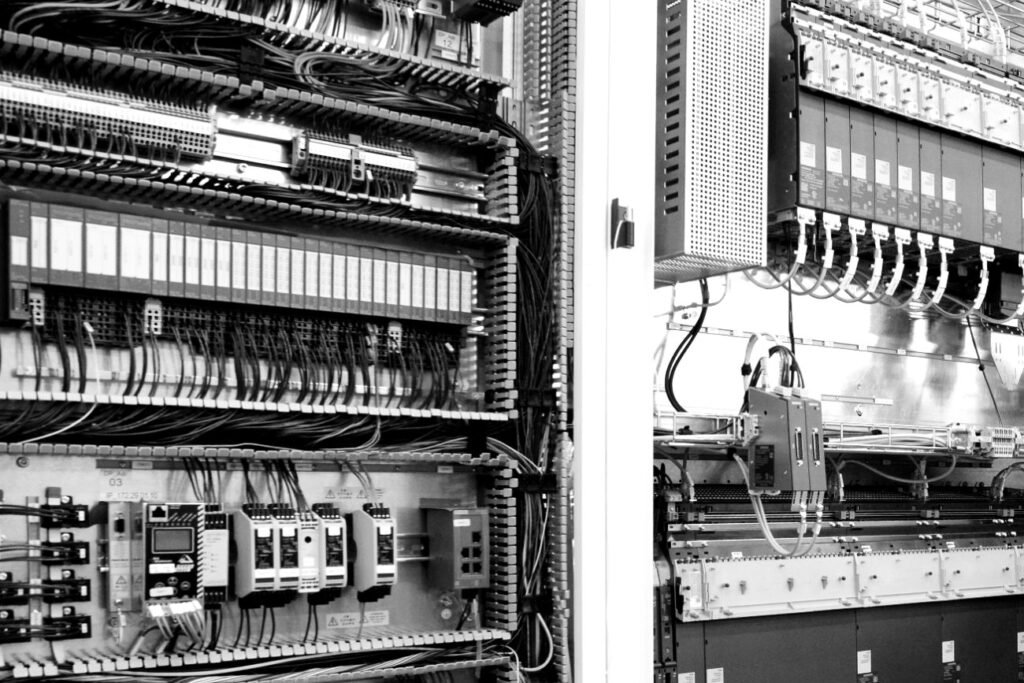
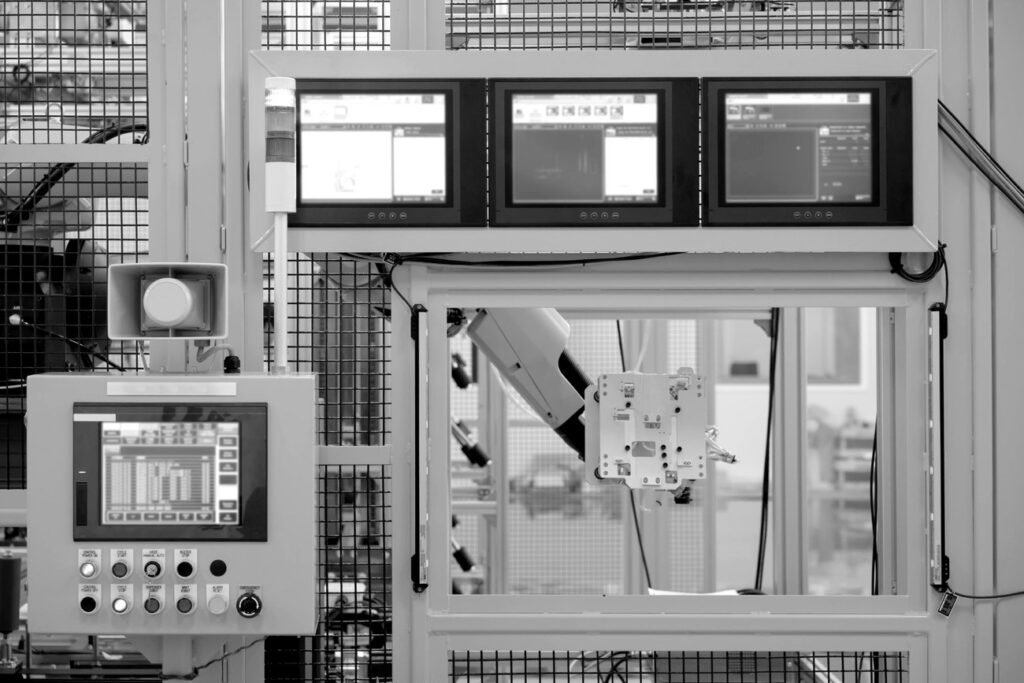
Definition of the electrical architecture and selection of the main components: decentralised I/O, fieldbus, drives and motion control. Design of the cabinets and their integration into the machine (cable routing, pluggable connectors for transport, accessibility for maintenance), in accordance with EN 60204-1. The schematics are drawn once the components are frozen, to avoid knock-on changes.
Mechanical and electrical design are closely linked: on a gripper or a dynamic system, close collaboration from the design stage onwards is essential.
Schematics and documentation
The teams I led produced the schematics in EPLAN, following standards agreed with production to make wiring and maintenance easier. I adapt to your tools and standards. Documentation is kept up to date through to the final as-built version of the delivered machine.
Automation
I have led teams working with Beckhoff, Siemens and Schneider Electric PLCs: control architecture, standardised programs, operating modes, networks and interfaces with robots and equipment. Sequences and cycle time are validated in the workshop before delivery.
Machine safety
I manage the complete process: risk assessment to ISO 12100, definition of the safety concept and required performance levels to ISO 13849-1, calculation with SISTEMA, then validation to ISO 13849-2.
Together with Pilz, I also set up in-house machine safety training, and worked with specialist risk-assessment consultancies when the customer required it.
Safety isn’t added at the end: it is designed in from day one.
CE conformity and international standards
I have mainly built machines for the Swiss and European markets, in accordance with the Machinery Directive and the Swiss Machinery Ordinance, up to and including the technical file and CE marking. I also have experience of North American requirements (OSHA, NFPA 79, UL) for export equipment.
I am keeping a close eye on the new Machinery Regulation (EU) 2023/1230, which applies from January 2027.
Balancing safety and production
I personally design safety solutions that protect operators without keeping them away from the process: guarding layout, component selection (light curtains, safety laser scanners or safety radar), suitable safety zones and operating modes, integrated robot safety functions (safely limited speed (SLS), monitored zones and tools) and, where appropriate, collaborative applications. I then oversee their implementation in the electrical schematics and safety programs.
Despite all the components available, safety is often a development project in its own right, requiring in-depth experience.
Software standardisation
I led the introduction of a common software platform for all automation projects: a proven, tested code base with around 60% reuse, and structured development in GitLab (issues, dedicated branches, systematic code review, testing) with agile management in Jira.
The platform is based on the principles of Clean Architecture, as formalised by Robert C. Martin: the core of the software is independent of the equipment and interfaces, which are arranged around it in successive layers. A robot, PLC or sensor can therefore be replaced without touching the rest of the software.
The result: projects get off the ground faster, quality no longer depends on a single developer, and each new project benefits from the experience of previous ones. I can support you in a similar approach to structure and standardise your own development.
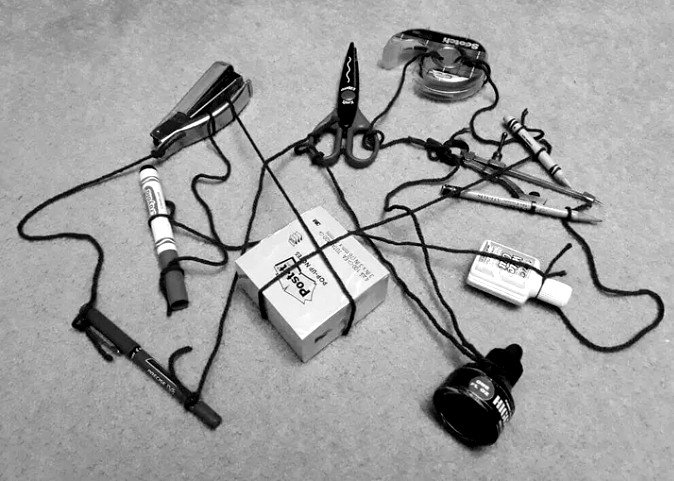
Before: every element depends on all the others 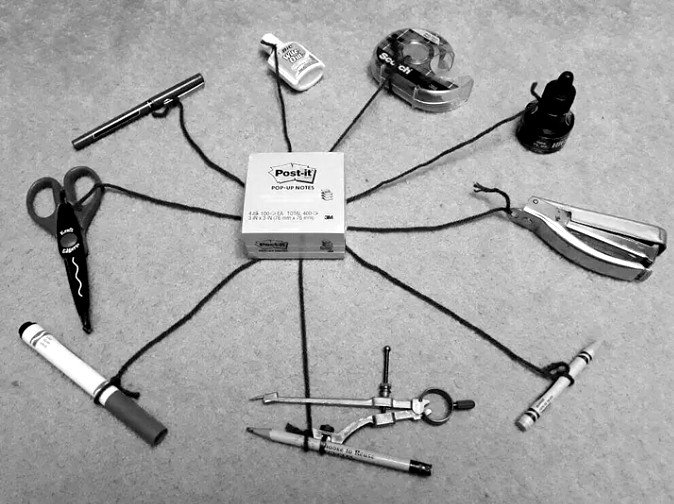
After: everything is built around a common core
Fully bespoke
I integrate a wide range of components: part feeding systems (vibratory bowl feeders and flexible feeding with a vibrating surface and vision), standard or linear-motor conveyors (Beckhoff XTS), presses, machine vision and bonding modules. I also integrate finishing and welding equipment: welding torches, gouging, brushing and grinding.
But bespoke work remains at the heart of what I do, both technically and in project management. For example, I integrated an automated guided vehicle (AGV) into a food sorting hall: a project far removed from conventional special-purpose machines, but the approach is the same. I understand the need, then find the right solution.
From parts weighing several tonnes to ruby wafers handled under laminar flow, every environment has its own rules. I also have solid experience with magnetic components, which are particularly tricky to handle.
Do you handle very unusual components or have specialist know-how? Let’s talk.


How I work
A successful special-purpose machine requires solid technical skills, but also real rigour in project management. Every project follows five stages, which I am happy to adapt to your company’s processes.

Preliminary phase
Before starting a project, I take the time to fully understand your needs, objectives and constraints.
Ideally, I get involved as early as the drafting of the specification. That is when the decisions are made that will determine the cost, lead time and performance of your future equipment.

Studies
The OEE of your future machine is largely determined at this stage. I select and validate the technical solutions before development begins.
If necessary, I carry out a feasibility study or build a test rig. A critical part of the equipment can also be developed first so that it can be tested and fine-tuned before integration.

Development
I start by validating the main components (robots, actuators, sensors) in a pre-development document, which serves as a common thread for the whole project team.
I carry out the mechanical CAD design and oversee the electrical schematics as well as the PLC and HMI development, run in parallel so that everything is ready for commissioning. This stage ends with a design review and a complete manufacturing package.

Manufacturing
Purchasing, assembly, wiring and electrical testing are followed by commissioning.
The machine is then fine-tuned under real production conditions before delivery. Your equipment only leaves the workshop once it works perfectly.

Installation
After the factory acceptance test (FAT), the equipment is delivered and installed at your site. Your teams are trained to become self-sufficient quickly, and the site acceptance test (SAT) closes the project.
Based in French-speaking Switzerland, I remain available after commissioning to support your equipment.
Services to suit your needs
From the first sketch to installation, you have a single point of contact who follows your project from start to finish. For manufacturing, I rely on trusted partners. But you don’t necessarily need a complete machine. I can also help with part of your project:

Simple or complex, let’s talk about your project.