
20 years of special-purpose machinery and robotics
For 20 years I have worked in industry, mainly for special-purpose machine builders in French-speaking Switzerland, as an engineer, project manager and then head of a 20-strong engineering department. I have designed, led or integrated equipment for a wide range of sectors: watchmaking, medtech, food, automotive, rail and heavy industry.
The projects below are ones I handled personally. I also took part in design reviews of my colleagues’ projects, which broadened my technical knowledge further.
They are presented anonymously, out of respect for the confidentiality of my former employers and their customers. My role is described for each one.
Watchmaking · Medtech and pharma · Food · Mechatronics and electronics · Industry · Department management · Career
Watchmaking
Components weighing a few milligrams, flawless finishes and micron-level precision.
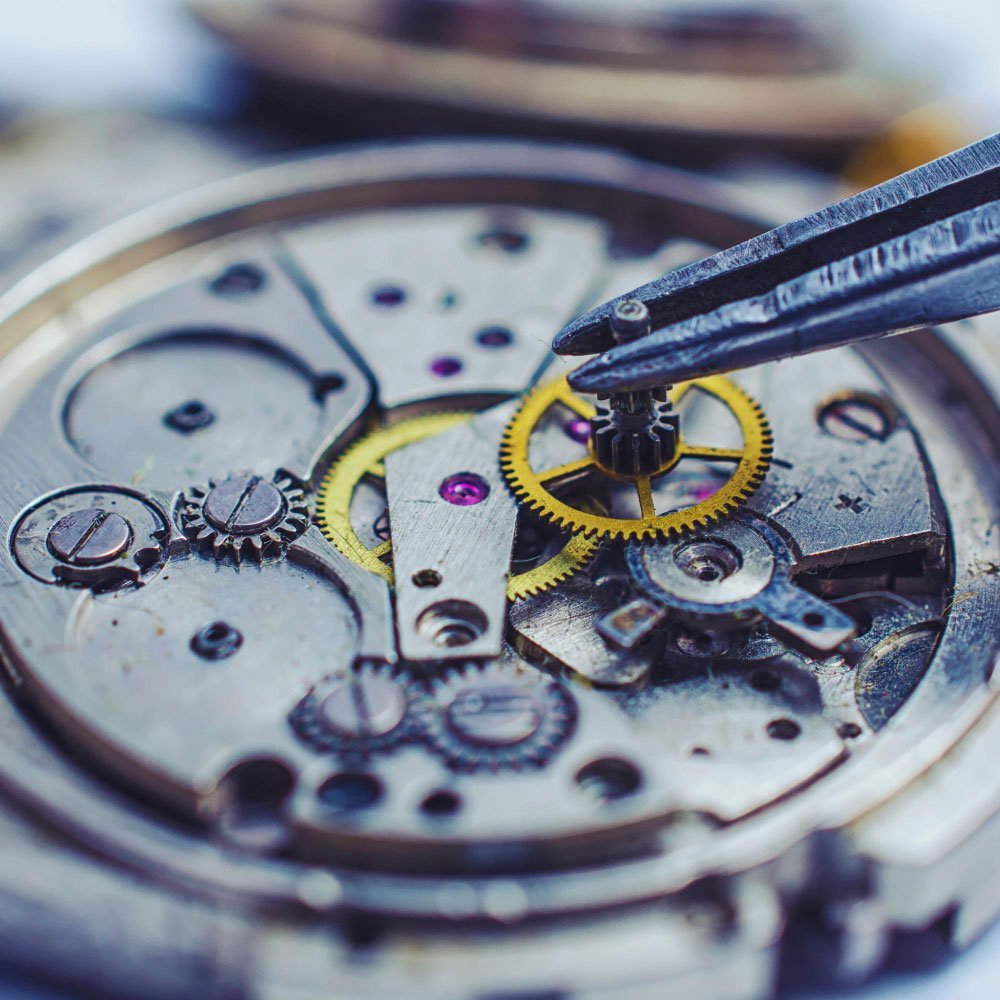
Standard production platform
Modular production line combining vision-based quality inspection, micro-component handling and welding. My 2012 study became the manufacturer’s standard platform, and it is still on the market today.
Brazing inspection for watch bracelets
Inspection machine that loads brazed links in tension and with a lateral force. A poorly brazed link moves further: measuring this displacement validates the brazing quality. The real difficulty was designing tooling that would not damage the links, some of which are gold.
Robotic sorting and assembly of bracelet link pins
Automatic sorting and feeding module, integrated into a machine that press-fits pins into bracelet links. This complete machine, with a rotary table and automatic loading, had been developed by a partner company and was in its third generation: studying it in detail gave me in-depth knowledge of pin press-fitting.
Laser engraving of watch case middles
Stand-alone laser engraving machine for case middles, with a 600-part storage magazine. Loading and unloading of standard watchmaking pallets in several formats. Seven identical machines are still in production today.
Compact arbor lubrication unit
Stand-alone production unit that applies precise quantities of lubricant to watch arbors. The electrics, pneumatics and process are integrated into a single compact module. The unit then fits into a complete watchmaking production line.
Automatic loading of a watchmaking press
Loading and unloading cell for a press that shears three holes in watch pinions. Parts arrive via flexible feeding and are handled by a linear-axis gantry.
Robotic loading cell for ruby wafers
Robotic cell serving a laser drilling station that drills the centre hole in ruby watch jewels, processed in wafer form. A robot with a custom gripper loads and unloads the wafers from a boxed storage magazine. The cell also includes a complete drilling inspection station, bought in and integrated in collaboration with its supplier.
Medtech, pharmaceutical and laboratory
Traceability, cleanliness and absolute reliability: equipment designed for strict regulatory and analytical requirements.
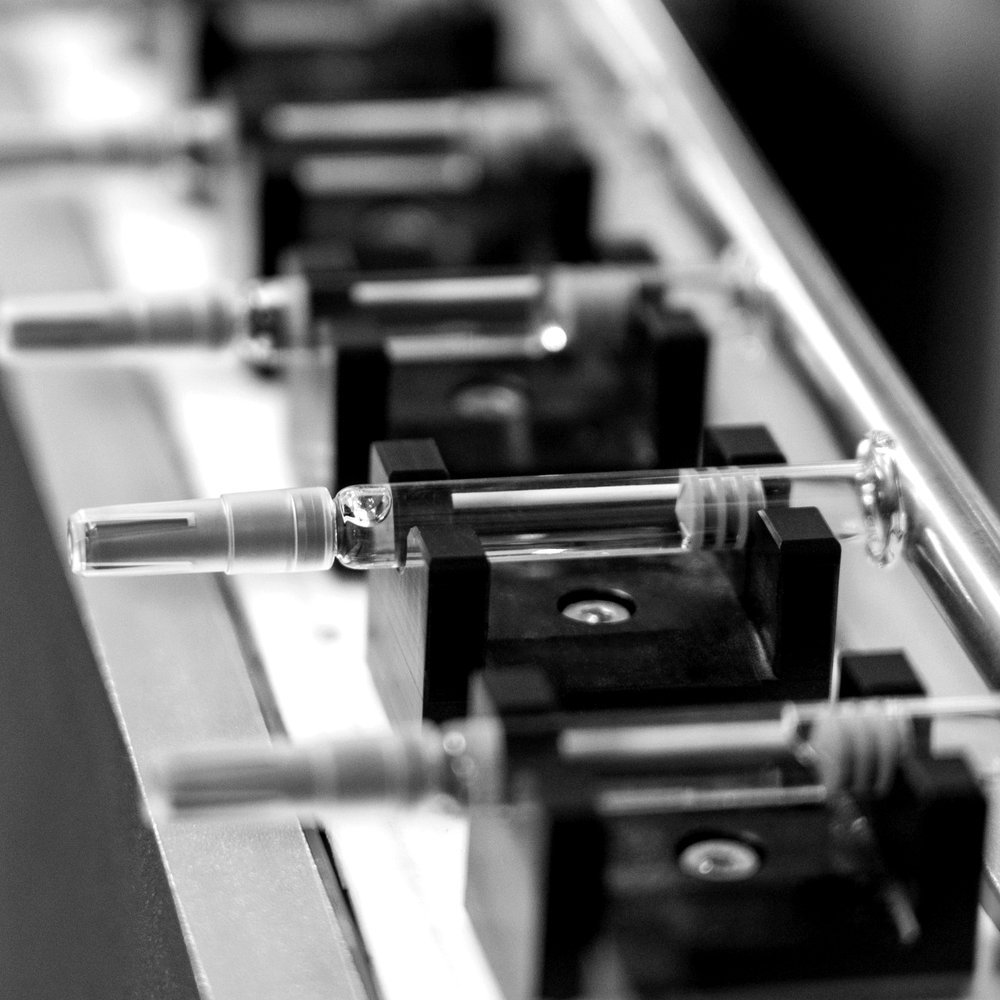
Assembly of implantable medical devices
Assembly machine for implantable medical devices, integrated into a production line. It assembles a battery, a connector, a printed circuit board and a housing: the leads are inserted into the board’s holes for reflow soldering, then the housing is fitted while all the parts are held in place.
A complete project, with strict medical requirements for precision and traceability.
Sorting and handling of pharmaceutical vials
Study of an XYZ gantry for sorting and handling vials, to be integrated into an existing production line for injectable hormone treatments. The project was taken through to a complete manufacturing package, ready for production to start.
Modification of a sterile sealing press
Modification of a press that seals the lidding on sterile syringe packaging, to improve seal quality and increase throughput on an existing line. I also proposed further improvements to the line in the form of studies.
High-speed handling of IV bags
Module integrated into an existing production line to increase its throughput. A gantry and slide-mounted grippers transfer the empty bags at 2.5 m/s. The challenges: combining stiffness with a lightweight gantry, controlling vibration, keeping control of the very light empty bags, which flutter at high speed, and making the transfer between the two modules reliable.
Injection mould on an XY table for inhalers
Plastic injection mould mounted on an XY table, producing inhaler inserts for people with asthma. One of my first projects, which introduced me to injection mould design.
Sheet-metal chassis for mass spectrometers
Design of the sheet-metal chassis for mass spectrometers, working closely with the fabrication shops to optimise the parts for series production.
Surface design of hearing aid earpieces
Surface modelling of earpiece shells for hearing aids, with complex, ergonomic shapes. I also worked on versions for demanding environments, which had to be guaranteed watertight.
Mechatronics, electronics and automotive
Complete lines for high-volume production, where every second of cycle time counts.
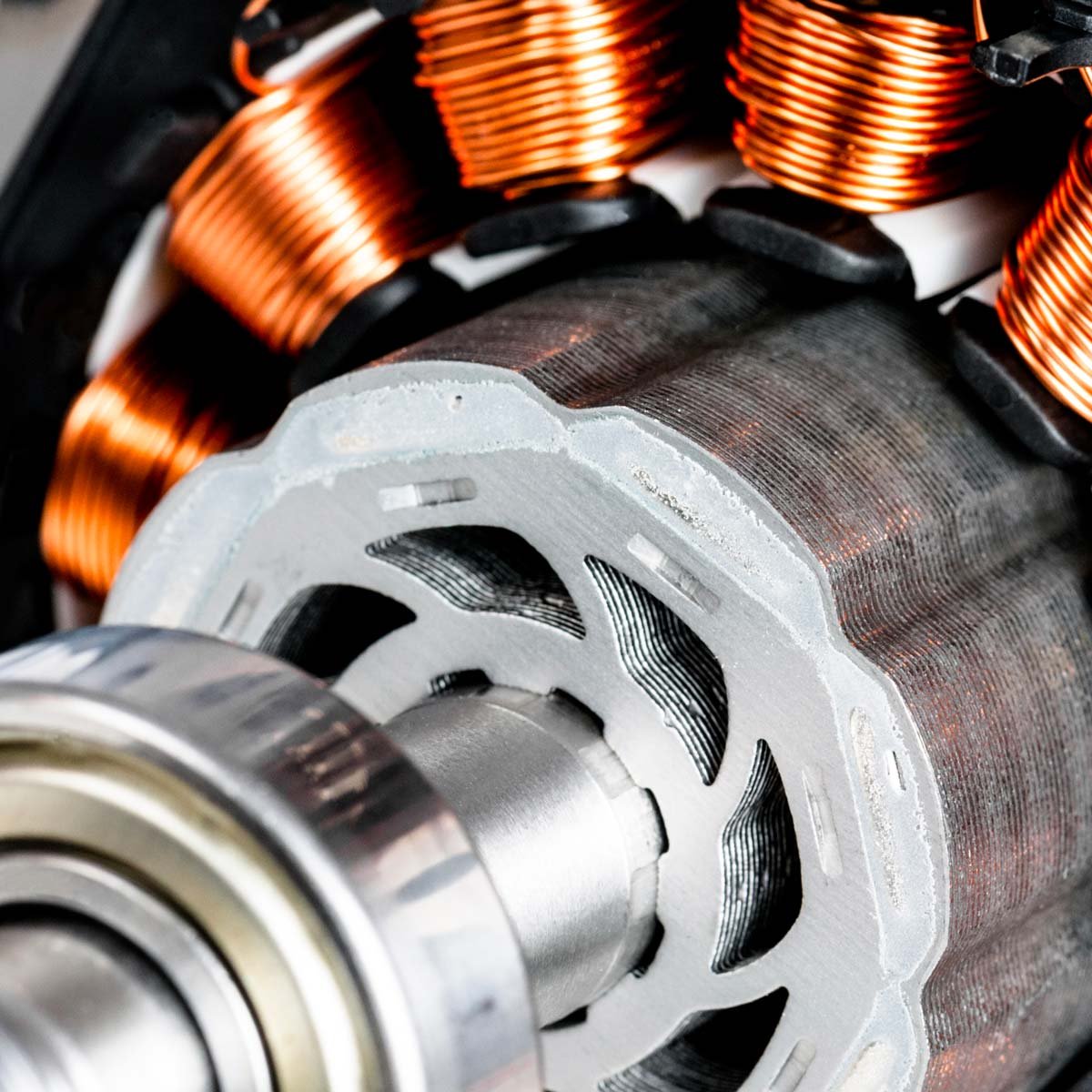
Assembly line for miniature actuators
Two identical lines, each with a capacity of 120,000 miniature electromagnetic actuators per week, for a consumer electronics product. Each machine combines 25 stations on a compact footprint: assembly of stators and micro-magnets, insertion of fragile connectors, UV bonding, vision inspection and electrical testing.
Several stations were developed entirely from scratch, notably the micro-magnet dispensing and the rotary table with its fixtures. The specification called for a cycle time of under 6 s: we achieved 5.5 s, which earned us a bonus from the customer.
Robotic line around an overmoulding press
Two machines linked by a 6-axis robot that loads and unloads an overmoulding press and handles the pallets. Its gripper packs 16 actuators and sensors into a 300 mm cube.
Both machines include SCARA robots, bowl and vibrating-surface feeding, separation of rotor micro-magnets, a rotary table, bushing press-fitting and inspection stations. The system forms part of a complete line built with other European partners to produce an automotive mechatronic component.
Motor production line
Study of a production line for a manufacturer of linear and rotary motors. I proposed a concept of carriers fitted with a rotary axis, travelling on a conveyor, which position each motor at the required angle for magnet placement.
EU PASTA project: electronics integrated into textiles
Participation in the European research project PASTA (FP7 programme, 2010–2015), coordinated by IMEC, alongside research centres such as CEA, Fraunhofer and CSEM. The aim: to integrate electronic micro-components (RFID chips, LEDs, sensors) directly into textile yarns for smart clothing and textiles.
For the production side, I designed and built a prototype production machine: a delta robot and a miniature flexible feeder place the micro-components onto the yarn, which is guided by a tensioning and feed system.
Food and consumer goods
High throughputs, varied products and hygiene constraints that call for robust, easy-to-clean solutions.
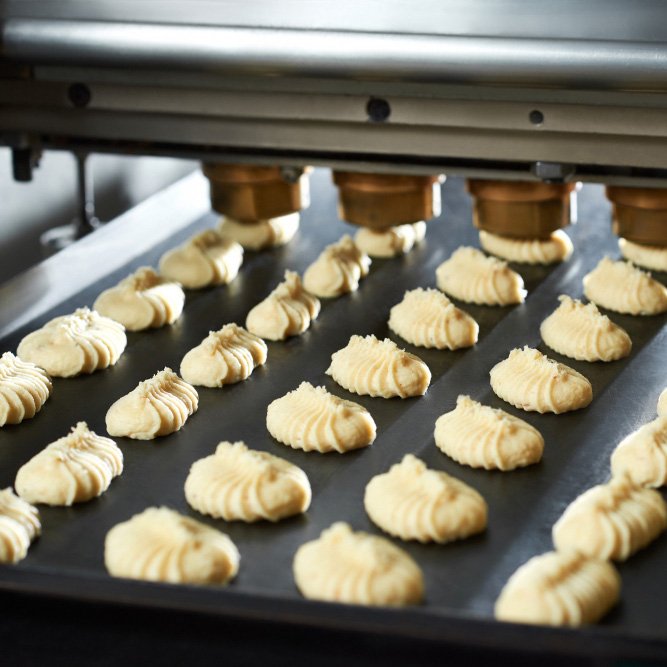
Vision sorting and boxing of colouring pencils
Automatic boxing equipment for colouring pencils. The pencils arrive from hoppers, one per colour, and are placed on a dedicated conveyor. The vision system checks the colour and detects each pencil’s orientation; the pencil is then rotated so that the logo faces upwards before boxing. Linear axes adjust automatically to the different box formats.
Brewing mechanism for a capsule tea machine
For a capsule tea machine, the capsule had to be brewed horizontally, whereas the user inserts it vertically, as with coffee. I designed a mechanism that, with a single lever movement, tilts the capsule to horizontal and closes the brewing chamber. This was my engineering degree project, carried out at a company specialising in capsule systems.
Palletising with humanoid robots
Integration of 15-axis dual-arm humanoid robots for palletising food products. Products arrive on a conveyor, are identified by vision, then picked by a vacuum gripper with automatic tool changing. A first experience with this type of robot: four of them are now in production at a major Swiss distribution centre.
Pallet inspection with deep-learning vision
One of the first industrial integrations of ViDi deep-learning vision, used to analyse pallets carrying a wide variety of food products. Compared with the previous vision system, deep learning made adding new products much simpler: the system just had to be trained on images, with no need to redevelop an algorithm.
Trolley sorting with an automated guided vehicle
Pilot line integrating an automated guided vehicle (AGV) to sort trolleys of around 500 kg in a food products hall. The project included purchasing and commissioning the AGV, in collaboration with its Dutch manufacturer, and developing a system that separates the trolleys and presents them to the AGV.
The challenge: trolleys with very varied contents, sometimes empty, and therefore very different weights and centres of gravity from one trolley to the next.
Laboratory machine for beverage capsules
Laboratory machine for testing processes before they move into production. It is built around an 8 m oval XTS transport system, to which interchangeable process modules are connected. The first module sealed the capsules, and the machine was designed to take further steps later, such as filling or extraction.
Industry, transport and construction
Heavy or large parts, and equipment that has to last.
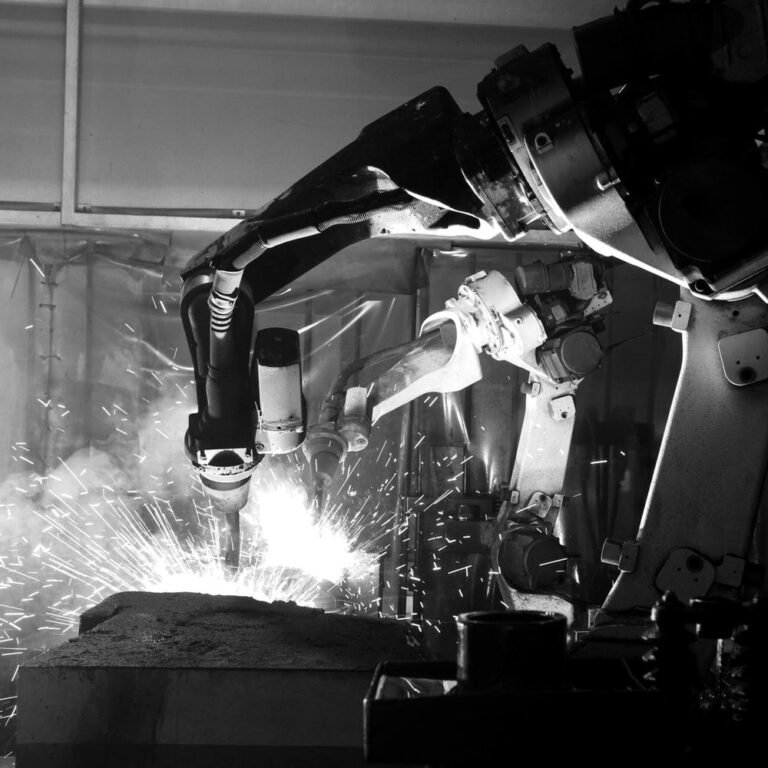
Robotic equipment for heavy industry
Large robotic special-purpose machines for welding and finishing heavy structures made from thick plate: multi-pass welding, gouging, grinding and brushing, from process development cells to gantries several metres long.
Study for robotic brick wall construction
Integration study for a 6-axis robot to build brick walls on site. Machine safety was the trickiest aspect: an industrial robot on an open construction site, surrounded by workers, cannot be safeguarded as it would be in an enclosed cell. At the end of the study, I identified an existing solution, an autonomous bricklaying robot such as the Hadrian X, which suited the need better than a custom development.
Study for straightening railway sleepers
Study of equipment to straighten worn and deformed railway sleepers, giving them a second life. Heavy parts and high forces: a design focused on robustness.
Filling trolley for train batteries
Compact trolley that can be moved by one person, used to fill and test the cooling circuit of large lithium batteries for rail applications. Fully automatic system with tank, agitator and pressure and flow measurement.
Automated assembly of blind slat curtains
Large machine that assembles the slat curtains of external venetian blinds. Coming off the roll former, the slats are fed by conveyor and positioned by a linear-axis pick-and-place unit and a lift. A SCARA robot inserts the hooks between the slats, which are then assembled and placed in the blind’s head box.
The challenge: a particularly delicate hook insertion module, and a machine with many mechanical movements to synchronise.
Sheet-metal modules for ticket machines
For ticket vending machines, I was tasked with finding a way for the ticket, normally dispensed vertically, to come out lying on its side. One of my first experiences in mechanical design, on sheet-metal sub-assemblies.
Running an engineering department
Since 2024, I have been heading a department of 20 engineers (robotics, electrical engineering, automation and software) at a special-purpose machine builder for heavy industry.
As a former mechanical designer and project manager, I speak everyone’s language and act as the link between the project managers, the design office and my teams.
Hands-on management
Regular one-to-one meetings, a monthly team meeting, weekly follow-ups by discipline and a frequent presence on the shop floor. In-house training develops versatility and knowledge sharing.
Shared methods
Systematic peer reviews, structured working methods beyond the department, and a framework linking each person’s activities to project milestones. Collaboration with other departments has improved markedly as a result.
Management tools adopted by other divisions
An automated multi-department, multi-project resource planning tool, now used by other divisions, complemented by task and hours-budget tracking.
Standards across all four disciplines
Standards and good practice so that every project benefits from the experience of the last. On the software side, a proven common code base now serves as the starting point.
Career
2024 – present
APCO Technologies, Aigle
Head of a 20-engineer department: robotics, software, automation and electrical engineering
2015 – 2024
TCI Engineering, Penthaz
Project manager reporting to senior management, mechanical design and SolidWorks PDM administration
2011 – 2015
CPA Group (CPAutomation, Asyril), Villaz-St-Pierre
Product manager, project manager and mechanical design
2008 – 2011
EnDes, Bösingen
R&D engineer on assignment with industrial clients
Before 2008
Monodor and Hentsch & Bovey
Engineering degree project and early experience during my studies

Let’s talk about your project
Does one of these projects resemble what you need, or do you have a challenge that’s unlike any of them? Let’s talk.